

Deep cut
Tuesday, October 27, 2026
Birmingham Friends Meetinghouse
Every Halloween week I end up thinking about graveyards, the way everybody does. This year I didn't want a ghost story.
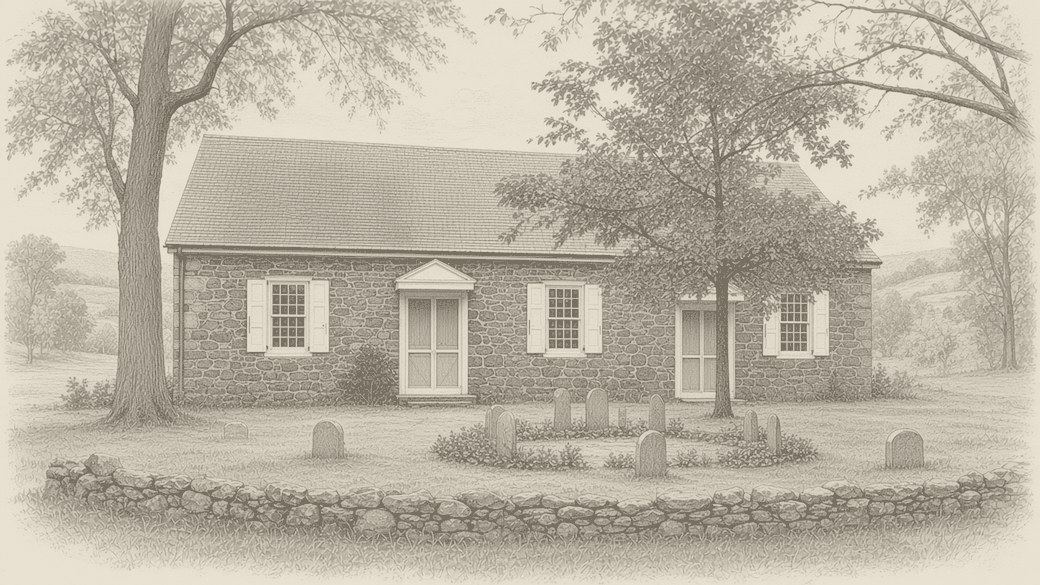
Every Halloween week I end up thinking about graveyards, the way everybody does. This year I didn't want a ghost story. I wanted a real one. So I drove a few miles south of West Chester to Birmingham Friends Meetinghouse, at 1245 Birmingham Road, and walked around behind the stone wall to the Peace Garden. That wall is low, made of fieldstone, and easy to step over. In 1777, soldiers crouched behind it.
A plain house on an old hillside
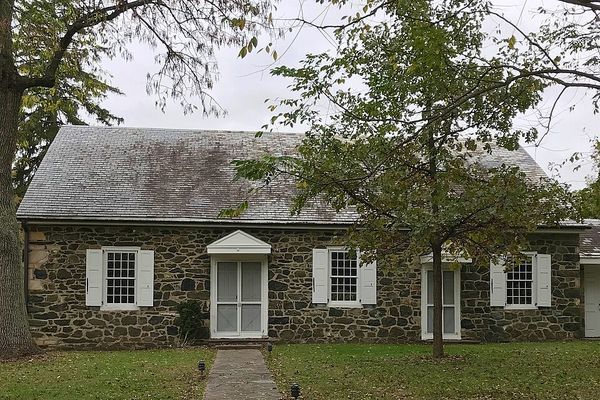
Birmingham Friends Meetinghouse sits in the soft hills where Birmingham Township runs down toward the Brandywine. It's a plain building, and that's on purpose. Quakers have worshipped on this ground since about 1690, and the sign out front still says "Established 1690." Their first meetinghouse here, built in 1718, was made of red cedar logs. In the 1750s Friends walled off a burial ground beside it. Then in 1763 they put up the stone house that's still standing, roughly 38 by 41 feet, with the same deep, quiet look you see at meetinghouses all over Chester County.
That wall around the burial ground had a simple job. It kept cattle out of the cemetery. Nobody who stacked those stones was thinking about armies.

Sept 11, 1777
On the afternoon of Sept 11, 1777, the quiet at Birmingham Friends Meetinghouse ended. The Battle of Brandywine had been building all day. When word reached the Continental Army that British troops were coming down on its right side, American brigades hurried north to meet them, and the land around the meetinghouse ended up near the center of the afternoon's fighting.
The burial-ground wall turned into a breastwork. A marker set on it in 1922 by the Pennsylvania Society of the Sons of the Revolution reads "First Defense Line, American Army." I stood there and tried to picture it, and it's hard, because today it's just a peaceful wall with trees behind it.
I'll keep the troop movements short, because the meetinghouse is the story here, and what happened to it next is what makes Birmingham unusual.
A hospital and a common grave
The meetinghouse belonged to people whose faith kept them from fighting, and it became a hospital. First it held wounded Americans. Then, after the battle moved on, it held British officers.
When the dead were gathered, British and American soldiers were buried together in one common grave inside the Quaker burial ground. They were enemies on a Thursday afternoon, and then they were laid in the same ground by Friends who had refused to take a side. Nobody recorded how many soldiers are in that grave, and I'm not going to guess. What matters is that they're there together, at Birmingham, and they've been there for almost 250 years.
You'll hear a lot of legends about old meetinghouse hospitals. I'm leaving those out. The real history of this place is heavy enough.
The schoolhouse and the quieter years
After the war, Birmingham Friends Meetinghouse went back to being a community place. A school had operated here since about 1753, and a 1911 Chester County Historical Society marker notes that its teacher John Forsythe later became the first head of Westtown School, which opened in 1799. The botanist Dr. William Darlington, one of the best-known names in West Chester history, went to school here.
In 1819 Friends enlarged the meetinghouse and finished a small eight-sided stone schoolhouse beside it. It cost $712.57. That octagonal school was in use off and on until 1905, and you can still see it standing next to the meetinghouse today.
Birmingham had its share of Quaker politics too. When Friends split in the 19th century, a separate Orthodox meeting worshipped in its own meetinghouse a few hundred yards south from 1845 to 1923. In 1968 a Quaker architect, Mather Lippincott, designed an education wing on the north side. The meetinghouse and the octagonal school went on the National Register of Historic Places together on July 27, 1971.
From a war grave to a Peace Garden
Here's the part that gets me. Sept 11 came back around. After the attacks on Sept 11, 2001, a member of Birmingham Meeting named Toni Brinton, a peace activist and gardener, had an idea for the old common grave. There are plenty of monuments to war, the meeting's own history points out, and not many to peace.
Another member, landscape designer Harriett Wentz, laid out a garden of native plants around the grave marker. Friends and visitors donated granite peace stones carved with quotations. The Peace Garden behind the burial-ground wall was dedicated in 2005. It's open to the public, and the meeting describes it as a place for contemplation that honors "those who lost their lives here."
So the same date, 224 years apart, shaped this one hillside twice. The first time it filled a grave. The second time it turned that grave into a garden.
Why Birmingham is the right stop this week
Late October is when we think about the dead, and Birmingham Friends Meetinghouse has a graveyard where the dead of two armies share one grave, tended for almost 250 years by people who refused to fight in the battle that filled it. You don't need a haunting to feel something there.
Go on a gray afternoon. The leaves are mostly down by now, and you can look out from the wall across the fields toward where the American line ran. It's about as moving as Chester County gets.
If you go
Birmingham Friends Meetinghouse is an active place of worship, not a museum, so please treat it that way. The Peace Garden and the burial ground are open to the public. Keep your voice down and stay on the paths.
Visitors are welcome at Sunday worship, 10 to 11:15am, in person or on Zoom. The meeting also gives tours of the meetinghouse and grounds by request through BirminghamFriendsMtg@gmail.com.
Walk the markers while you're there. There's the First Defense Line marker on the wall and the Friends School marker, along with monuments to Lafayette and Pulaski nearby. Lafayette was wounded somewhere nearby during the battle, but where exactly is disputed, so don't take anyone's word that it happened inside the meetinghouse. For the full battle story, Brandywine Battlefield Park in Chadds Ford is the place to go next.