
Deep cut
Tuesday, October 20, 2026
Frick's Lock
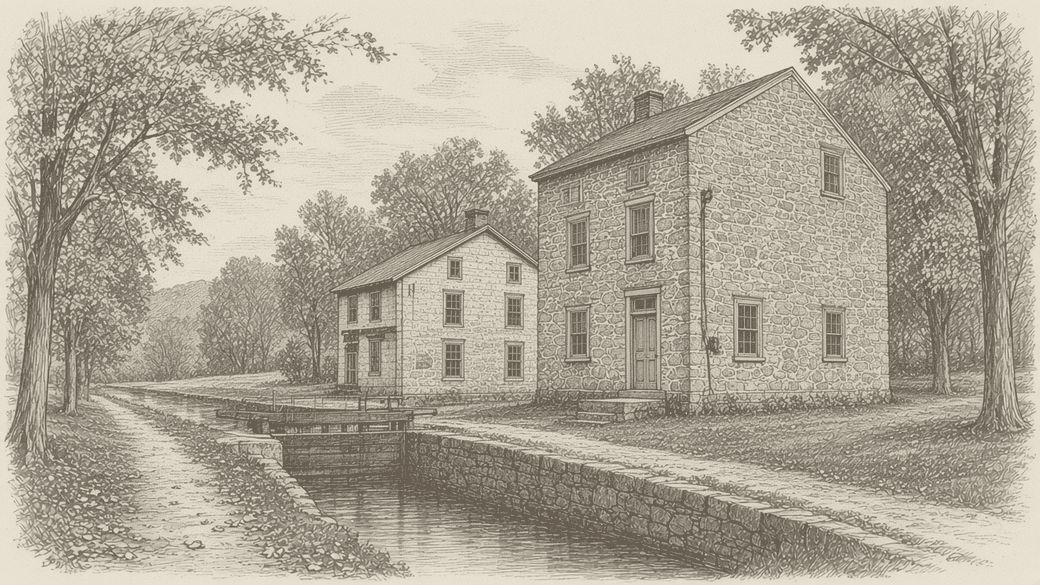
I went looking for Frick's Lock because of a photo. It showed an old stone house with its windows boarded up, weeds up to the sills, and right behind it, across the Schuylkill, two enormous cooling towers putting out steam.
I went looking for Frick's Lock because of a photo. It showed an old stone house with its windows boarded up, weeds up to the sills, and right behind it, across the Schuylkill, two enormous cooling towers putting out steam. It looked like a movie poster. I assumed it was somewhere out in the middle of the state. It's in East Coventry, about fifteen minutes up the river from Phoenixville.
Frick's Lock is a real village, a cluster of 1700s and 1800s buildings at 503-508 Lower Fricks Lock Road. Nobody has lived there for decades. And this Saturday, Oct 24, East Coventry Township runs its last free guided tour of the year, at 10, 11:15, and 12:30. You don't need to register, there's no charge, and the whole tour is outdoors. The township's tour page also says, very plainly, that the village "is not open for paranormal investigations." I respect that.
So why is a whole village sitting empty next to a nuclear plant, and why is it still standing? The answer runs through one small piece of riverbank.
A farm on the river
Before the canal, before the name, Frick's Lock was farmland on a bend of the Schuylkill. According to the township's history, the Lenape trapped beaver along this stretch of river, and the woods were oak, hickory, and chestnut. In 1749 the Grumbacher family bought the parcel that would become the village. The first building anyone knows of here is their farmhouse, built in 1757, and it's still standing.
The name came through marriage. John Frick married Catherine Grumbacher in 1781, and the couple moved onto the family land. Over the years Frick ended up owning the ground the village would grow on. He died in 1822, just before the thing that made his name stick: a canal dug right across his farm.
The canal that named it
The Schuylkill Navigation Company was chartered in 1815 to move anthracite coal from the mines above Pottsville down to Philadelphia. Instead of fighting the river's falls and shallows, it built a chain of canals, dams, and locks, and two of those locks landed on the Frick farm. The township's history puts the canal about 100 feet north of the old farmhouse, with the double lock about 250 feet west of it. Boats came through Frick's Lock and had to stop, and anywhere boats have to stop, a town starts to grow.
That's what happened here. The village kept a store that stayed open 24 hours a day for the boatmen, who were working around the clock. Passengers on packet boats came ashore for dinner, or stayed the night to catch a stagecoach. In 1849 a covered toll bridge, the Lawrenceville Bridge, gave the area its first dry crossing of the river and opened up trade with Montgomery County. The Pennsylvania Railroad put a station at Frick's Lock in the 1880s, and the village got its own post office in the 1890s.
For a stretch of the 1800s, this little spot on the river was a real crossroads.
When the boats stopped
Railroads were faster, roads got better, and the canal couldn't keep up. Floods filled in parts of it in the mid-1920s, and it closed for good around 1930. Without the boats, Frick's Lock went back to what it had been at the start: a few farms on a quiet bend of the river. The people stayed, though. For decades it was just a small, out-of-the-way village that most of the county never thought about.
The plant across the river
Then, in the 1960s, the Philadelphia Electric Company started building the Limerick Generating Station on the far bank, right across from Frick's Lock. In 1969 and 1970, PECO bought up the parcels that make up the village.
The reason is simple. Federal rules for nuclear plants exclude certain uses, including homes, within a 2,500-foot radius of the plant. Frick's Lock was inside that ring. According to the township, most of the buildings were already boarded up and empty by the time PECO bought them. By the time Limerick came online in 1986, everyone was gone. Stories differ about how the last residents left. What's certain is that the village emptied, and the windows got boarded up.
A ghost town, by reputation
An empty village with boarded windows and cooling towers in the background gets a reputation fast. Frick's Lock turned up in the 2005 book Weird Pennsylvania and in plenty of online photo essays. Urban explorers came. So did vandals and partyers. Porches collapsed, and in February 2008 a fire destroyed the old locktender's house. The haunted reputation is just that, a reputation, built out of empty rooms and No Trespassing signs. Mostly it brought a lot of people who wandered in where they shouldn't have.
Saved by the same rule
Here's the irony at the center of Frick's Lock, and it's why I love this place. The rule that emptied the village also protected it. Once one owner held all the land, and homes were off the table inside the buffer, no developer could knock the old buildings down for houses. The township's history says it directly: combining the parcels under one owner, plus the limits on how the land could be used, did a lot to preserve the historic area. Frick's Lock didn't get bulldozed or cut into lots. It just sat there, waiting.
People who cared stepped in. Paul S. Frick pushed to document the village's history, and in November 2003 about 18 acres of it were listed on the National Register of Historic Places. In 2011 Exelon, which owned the plant by then, reached an agreement with East Coventry to preserve the village and turn it over to the township. A $2.3 million restoration was announced in 2013, the work won a Preservation Alliance for Greater Philadelphia award that year, and the township's Historical Commission started giving tours. Constellation, which now runs the plant, stabilized and rehabilitated the buildings and allows escorted public access.
How to see Frick's Lock
Go on a tour. That's the only way in. The village is posted no trespassing and sits inside the plant's buffer, so please don't go poking around on your own.
Saturday Oct 24 is the last date of the 2026 season, with tours at 10:00, 11:15, and 12:30. They're free, you don't need to register, and they run rain or shine unless there's thunder or lightning. The tour is all outside, so wear real shoes and dress for the weather. Volunteers from the township's Fricks Lock committee lead it, along with the plant's owner.
Make a morning of it. The Schuylkill River Trail runs right along this stretch of river, so walk a bit of it before or after. Stand by the old canal bed, look across the water at the towers, and think about the farmhouse from 1757, the store that never closed, and the plant that, without meaning to, saved Frick's Lock. Then go home and tell someone you visited a ghost town on a Saturday morning, with a guide.