
Deep cut
Tuesday, November 3, 2026
Hannah Freeman's markers
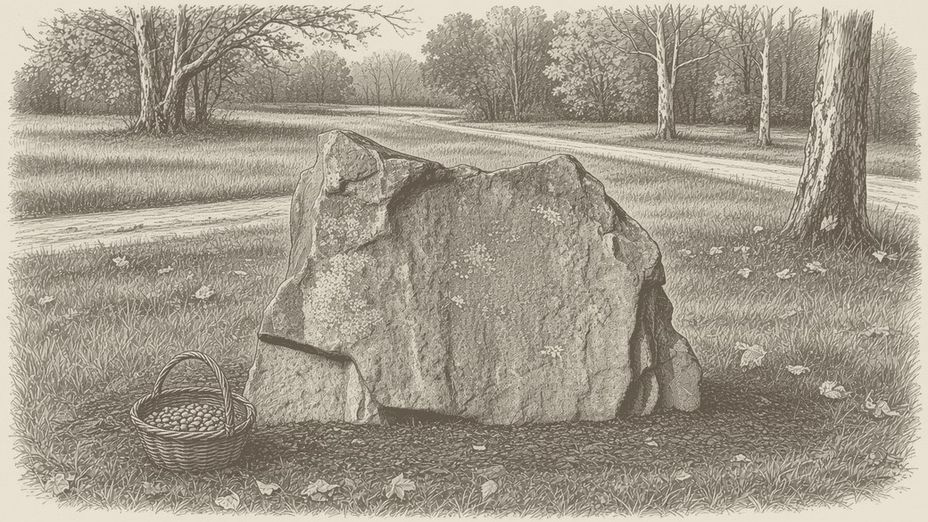
I've driven past the boulder on Route 52, just north of Route 1, more times than I can count, and I never once read it. This month I finally pulled over.
I've driven past the boulder on Route 52, just north of Route 1, more times than I can count, and I never once read it. This month I finally pulled over. November is Native American Heritage Month, and the woman on that plaque deserves more than a glance from a moving car. Her name was Hannah Freeman. The Brandywine Valley has marked her life with three boulders, a memorial at Longwood Gardens, and a road. None of those markers sits where she asked to be buried.
A life on the Brandywine
Hannah Freeman was born around 1730 into a Lenape family living along the Brandywine. She grew up speaking Unami, the Lenape language, and English, in a household of women: her grandmother, her mother Sarah, and her aunts. She worked the way a lot of rural people did back then. She spun and sewed, made brooms and wove baskets, and worked for Quaker farm families along the creek. Neighbors knew her as a healer who used native plants. She kept a small garden, and she followed a seasonal circuit along the Brandywine that reached south into what's now Delaware.
That creek is the thread through her whole story. The Brandywine was her family's home before the farms showed up, and it stayed her home as the farms filled in around it.
Leaving the Brandywine, and coming back
The 1700s were rough on the Lenape families still living along the Brandywine. During the French and Indian War, her family moved to Chester Creek in 1758 to stay out of harm's way. Then in December 1763, a vigilante mob called the Paxton Boys massacred a peaceful Conestoga community in Lancaster County. Lenape families in Chester County had every reason to fear they were next. Hannah and her relatives fled to New Jersey, and they stayed about seven years.
When they came back to the Brandywine, the valley had kept changing without them. There were more farms and more fences, and less room for a family that had lived on that creek long before anybody drew up a deed.
Losing her people
The women who made up Hannah Freeman's world died one by one. Her grandmother died in 1775, her aunt Betty in 1780, and her mother in 1785. By the 1790s Hannah was in her sixties, sick with what the sources describe as rheumatism, and moving between Quaker households in Newlin Township, working for her room and board.
In 1797 she was declared indigent. The next year, 34 of her neighbors in the valley signed an agreement to share the cost of caring for her. Historians still point to that as a small act of community inside a hard story, and I think it deserves to be remembered right next to everything else.
Embreeville
In 1800, Chester County opened a new almshouse, a county poorhouse, on farmland at Embreeville in Newlin Township, along the West Branch of the Brandywine. Hannah Freeman was admitted there on Nov 12, 1800. She died there on March 20, 1802.
She had asked to be buried in an old Indian burial ground by the Brandywine. She was buried in the almshouse's potter's field instead, the first burial there. The almshouse later became Embreeville State Hospital, which has since closed. Her grave marker is on the grounds of that former county almshouse. It isn't a place to wander onto, so I'm not giving directions to it here.
"The last of the Lenape"
This is where the story at Embreeville turns from sad to something harder to sit with. For generations, Hannah Freeman was remembered as "the last of the Lenape." Historians point out how convenient that label was. Colonial-era promises held that the land belonged to the Lenape until the last of them was gone. Calling one poor, elderly woman in a poorhouse "the last" helped settle questions about land her people never willingly gave up.
The label was wrong. Lenape people did not disappear from the Brandywine or anywhere else. Lenape nations and communities exist today, including the Delaware Tribe of Indians and the Delaware Nation in Oklahoma, and Lenape communities in New Jersey and Ontario. Lenape groups have also been working toward a return to the Brandywine, as WHYY has reported.
The markers
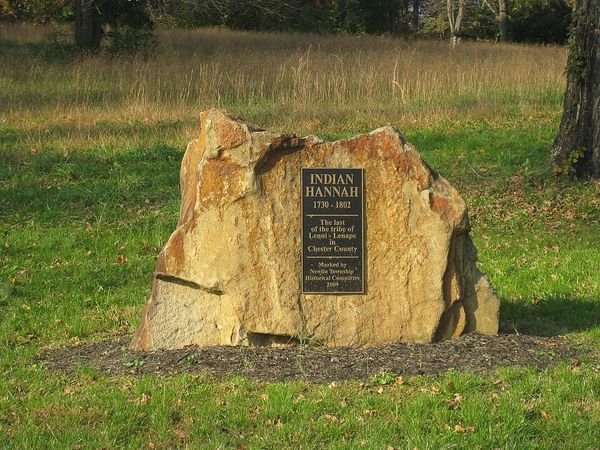
So where do all those boulders come in? In 1909, the Chester County Historical Society put a bronze plaque on a boulder at her grave site near Embreeville. In 1925, the Pennsylvania Historical Commission and the historical society marked her birthplace with a second plaque on a boulder along Route 52, just north of Route 1. That's the one you can see from the road. The Newlin Township Historical Committee later placed a third boulder in a Newlin meadow, with a plaque that names her "Indian Hannah."
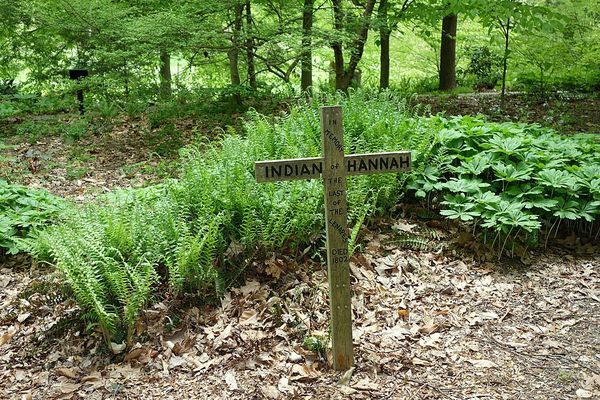
At Longwood Gardens, a simple memorial carries on a tribute started by the Peirce family, who owned that land in the 1800s. It's a memorial, not her grave. Its old wording repeats the "last of the Lenapes" line, which shows you exactly how a myth gets set in stone. Locals also know Indian Hannah Road. "Indian Hannah" is the name the markers and the road use. Here, I'm calling her Hannah Freeman.


What's still here
Two baskets attributed to Hannah Freeman are in the Chester County History Center's collection in West Chester. And then there's the bean. Truelove Seeds grows and sells the Hannah Freeman bean, a Lenape heirloom it credits her with keeping alive. You could plant it in a Chester County garden next spring, a few miles from the creek where she grew up. I love that one of the things that outlasted her is still growing.
Going to see the markers
If you want to pay your respects, the Route 52 boulder is visible from the roadside just north of Route 1. Pull off somewhere safe. The Longwood memorial is on the grounds with regular admission. Go quietly, read the plaques, and keep in mind that the wording on them is part of the story too.
The Brandywine still runs past all of it, the meadow boulder in Newlin, the stone on Route 52, and the old almshouse ground at Embreeville. The truest monument to Hannah Freeman might be the plain fact that the people those markers called "the last" are still here.